Leather Bed Frames: PU vs. Genuine Leather and Quality Checks
A leather bed frame should be compared by its actual covering material, where that material is used and how it performs in the finished upholstery. Textile-backed PU upholstery is a coated fabric; genuine leather has an animal-hide or skin substrate. Both can have surface finishes, so a smooth texture, embossed grain or glossy photograph does not establish what lies underneath.
For a useful comparison, identify the covering and backing first, then check the headboard, side rails and footboard separately. Finally, review evidence relevant to the intended environment, cleaning routine and upholstered construction. This separates material identity from quality: a genuine-leather description is not a complete durability specification, and a PU description alone does not tell you how a particular coating will perform.
What Does “Leather” Mean in a Bed Frame Description?
The material specification needs to distinguish the substrate from its surface. Leather Working Group’s terminology identifies leather by its animal origin and retained fibrous structure, while distinguishing grain, split and coated forms. Genuine leather may be pigmented or carry a polymeric finish. A polymer layer on the face is therefore not, by itself, proof of a textile-backed imitation.
For a bed advertised as “PU leather,” ask whether the upholstery is polyurethane-coated textile, a composite construction, or a differently finished substrate. Identify the actual covering and backing rather than relying on the marketing phrase. Do not use a destructive burn, scratch or solvent test on a finished bed as an authenticity shortcut.
| Description | What needs to be identified | What the name does not establish |
|---|---|---|
| Textile-backed PU upholstery | Coating system, supporting fabric or substrate, material reference and finish | A particular resistance to humidity, cleaners, flexing or wear |
| Genuine leather | Leather type, grain or split structure, finish and material reference | A single quality grade, an uncoated surface or a guaranteed service life |
| Coated or composite material | Complete layer construction and an accurate supplier description | That the visible face represents the entire material |
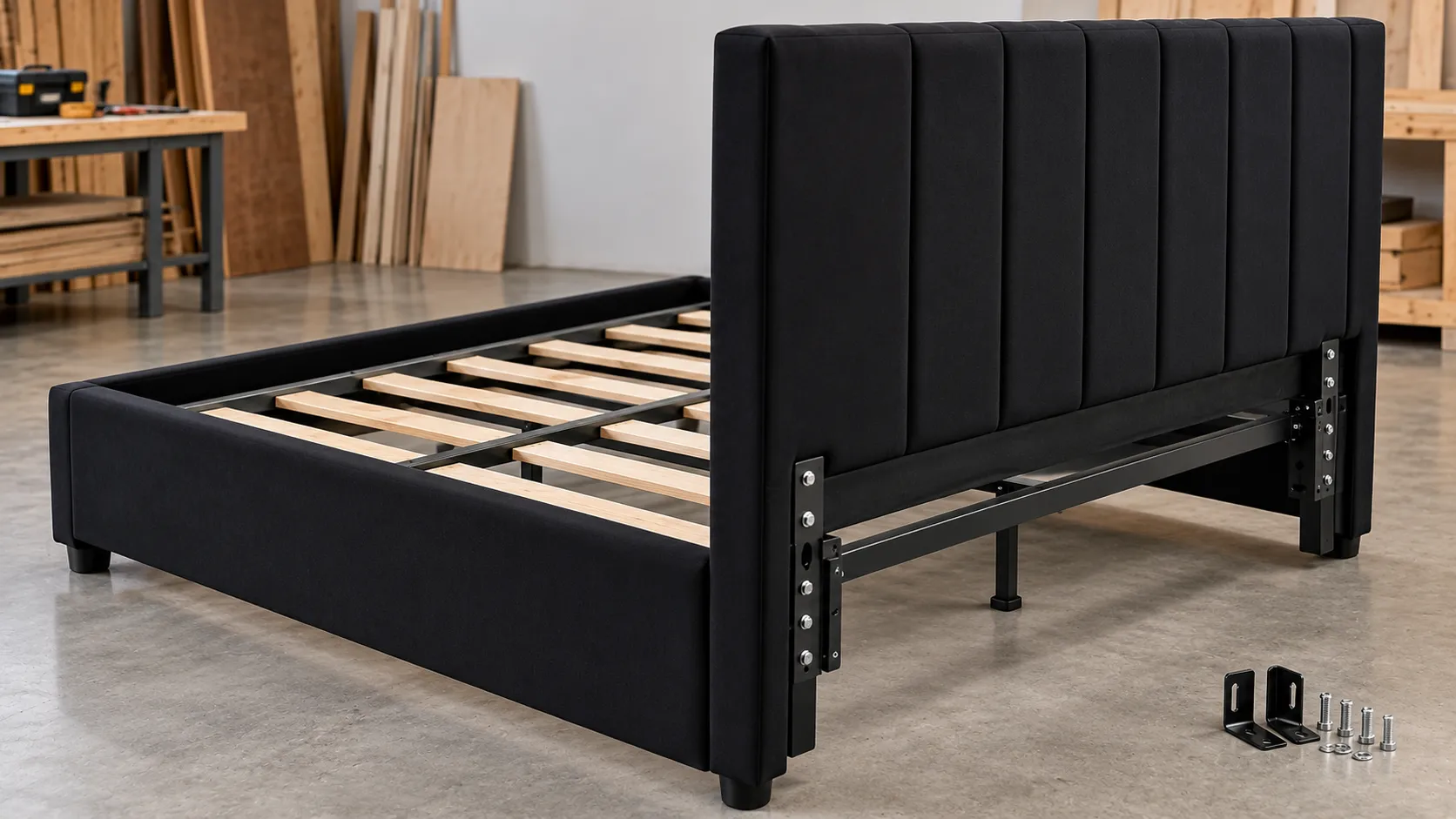
Shilong explicitly describes its black PU upholstered bed frame as having a square-tufted PU-covered headboard, an internal metal frame and wooden slats. Use that stated material description when assessing the model. It should not be relabelled as a genuine-leather bed.
Check Which Parts of the Bed Use Each Material
A headboard photograph cannot establish the covering on every surface of a bed. Specify the headboard face and back, side rails, footboard and any visible edge or trim separately. This is a material-recording method, not an assumption that a particular supplier mixes materials.
Attach a material code, color reference and finish description to each relevant position. Where different coverings are intentionally selected, make the boundary clear in the drawing and product description. A buyer approving only the headboard swatch may otherwise leave the treatment of the remaining bed unspecified.
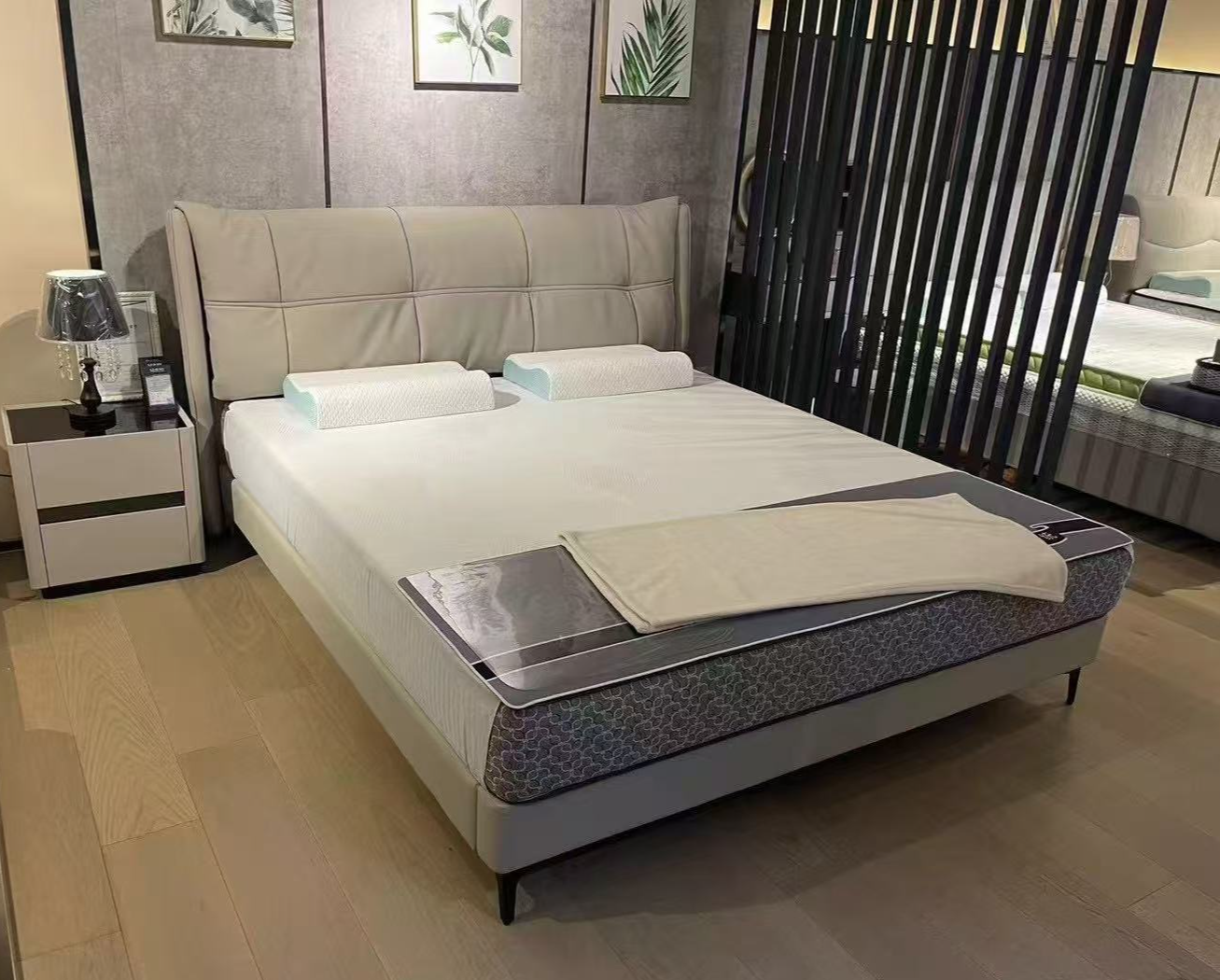
Shilong’s beige upholstered bed frame material options include PU or fabric in the specification table. Confirm the option for the quotation and sample; the color of the displayed bed does not establish which covering will be supplied.
Keep the covering record separate from the foam, panel structure, internal support frame and slats. Changing the visible material does not independently establish a change in mattress support or bed-frame capacity. Conversely, a structural improvement does not prove that the selected surface is compatible with the intended cleaning products.
Compare PU and Genuine Leather Using the Same Criteria
There is no useful blanket verdict that every PU bed is inferior or that every genuine-leather bed will last longer. Compare two identified materials on the same bed design and for the same use. The following questions make the comparison more informative than a list of general advantages.
| Decision | For a PU-covered bed | For a genuine-leather-covered bed |
|---|---|---|
| Material identity | Confirm the coating and supporting substrate | Confirm the leather type and surface finish |
| Required appearance | Approve the actual grain, gloss and color range | Approve the actual finish and acceptable appearance variation |
| Room environment | Review relevant evidence for the exact coated material, including heat/humidity exposure where applicable | Review the supplier’s conditions for the specific leather and finish |
| Cleaning routine | Confirm products and methods compatible with the coating system | Confirm products and methods appropriate to that finish; do not assume one treatment suits all leather |
| Upholstered construction | Assess the material over the actual foam, corners, tufting and seams | Assess the material over the same agreed bed construction |
| Commercial comparison | Compare the complete quoted covering scope and required evidence | Use the same part coverage, bed size and acceptance requirements |
Choose a documented PU specification when that covering meets the intended design and use conditions. Where animal-origin leather is a project requirement, state it explicitly and obtain a matching material specification. In either case, pause approval when the supplied sample, written description and quotation describe different materials.
Price comparisons also need the same scope. A quotation for a headboard face alone is not comparable with one covering the headboard, rails and footboard. Without matching material references and part coverage, a price difference does not show whether one supplier offers better value.
Keep environmental claims separate as well. A material name alone does not establish recycled content, recyclability or a lower environmental impact. Those claims require their own defined scope and supporting evidence rather than an assumption based on “synthetic” or “natural.”
What Can Cause Peeling, Cracking or Upholstery Failure?
Heat, humidity and PU hydrolysis
Hydrolysis is a chemical degradation process associated with prolonged heat and humidity. The Association for Contract Textiles (ACT) explains that polyurethane-coated fabrics can be vulnerable, with resistance affected by formulation and manufacturing. Cracking, flaking or separation of the film may result, but a PU label does not identify the resistance of a particular material.
Similar damage can also follow unsuitable or excessive cleaner exposure. A photograph of peeling is therefore a clue, not a complete diagnosis. Record the material reference, exposure history and products used before attributing the failure to one cause. Use cleaning guidance for the specific upholstery rather than assuming a general-purpose disinfectant is compatible.
Coating adhesion, flexing and seams
Other failures involve the bond between a coating and its substrate, repeated bending, or tearing around needle holes. These are different properties. A material can perform well in one evaluation while still needing attention elsewhere.
On a tufted headboard, review the actual depressions, returns and stitching rather than only the flat central panel. At a wrapped corner, look for local distortion and excessive pulling. Along a seam, check that the approved construction produces a consistent appearance without visible tearing or coating disruption. These observations guide sample review; they do not replace a test or identify a universal allowable defect size.
If a problem appears only after upholstery, compare the flat material and the assembled sample. That comparison helps separate a material question from a fabrication question. Do not conclude that every surface crack proves poor raw material, or that an intact flat swatch proves the finished bed is satisfactory.
Which Test Results Are Useful—and What Do They Not Prove?
Ask what property each report measures before comparing its headline number. ACT’s February 2025 guidance for indoor coated fabrics distinguishes coating adhesion, tear and breaking strength, seam-related resistance, flexing and hydrolysis. These are separate checks, not alternative names for a single durability score.
| Evidence | Useful question | Important limit |
|---|---|---|
| Coating adhesion | How does the coating resist separation from its support? | It does not independently establish cleaning compatibility or whole-bed durability |
| Flex and seam-related tests | How does the identified material behave under the specified deformation or seam test? | The actual upholstered detail still needs review |
| Hydrolysis testing | How does the PU-coated material respond to the stated heat/humidity exposure? | Laboratory exposure weeks are not service-life years |
| Abrasion testing | How does the surface perform under the named abrasion procedure? | A higher cycle count does not establish a proportionally longer life |
Match each report to the quoted material code, backing, coating and relevant version. Record the test method, result, evaluation criterion and date. A report for another fabric in the supplier’s collection cannot be transferred merely because the two swatches share a color.
Abrasion deserves particular caution. ACT explains that Wyzenbeek and Martindale results address flat abrasion and do not cover every type of edge wear in upholstered products. A material that survives twice as many laboratory cycles cannot automatically be described as lasting twice as long. Compare applicable evidence without turning a test count into a warranty.
For PU hydrolysis, retain the laboratory exposure units used in the report. ACT explicitly cautions against converting test weeks to service years. Its guidance is voluntary industry guidance, not a Shilong certificate, a universal bed regulation or proof that a quoted upholstery has passed.
Do not apply a coated-fabric test package indiscriminately to every genuine leather. Select methods and criteria appropriate to the material and intended application with the supplier or qualified laboratory. Likewise, material testing does not establish the strength of the complete bed frame.
Review the Upholstered Sample Before Approving Production
A flat swatch answers appearance and material-identity questions; an upholstered sample shows how the selected covering works with the bed’s foam, seams, corners and fastening details. Both belong in the approval record.
Begin by checking that the sample uses the material codes in the agreed part-by-part specification. Review texture, color and gloss under consistent lighting, then examine the actual tufting, edge returns and seams. Define acceptable appearance against that sample rather than relying on a catalogue photograph.
Material recovery after stretching is also affected by the furniture construction, including foam characteristics. ACT does not reduce this interaction to one universal minimum. Review it with both the covering supplier and the furniture manufacturer when developing the upholstered assembly.
A practical approval record brings together the component material map, selected swatches, relevant test documents, finished sample reference and cleaning instructions. Any change to covering, backing, foam or fabrication details should be reviewed for its effect on the approved result rather than treated as an invisible substitution.
For Shilong’s PU upholstered models, keep the order aligned with the stated PU or fabric configuration and the approved sample. Genuine leather remains a separate material choice that must be expressly confirmed; it should not be inferred from a leather-look photograph or the general availability of customization.
The most useful leather-bed comparison identifies the substrate, maps the covering to each bed component and checks evidence for the actual use conditions. To confirm upholstery materials and sample requirements with Shilong, provide the bed design, required part coverage, target finish, intended environment and the documentation your project needs.