How to Attach a Headboard to a Bed Frame: Fit and Mounting Guide
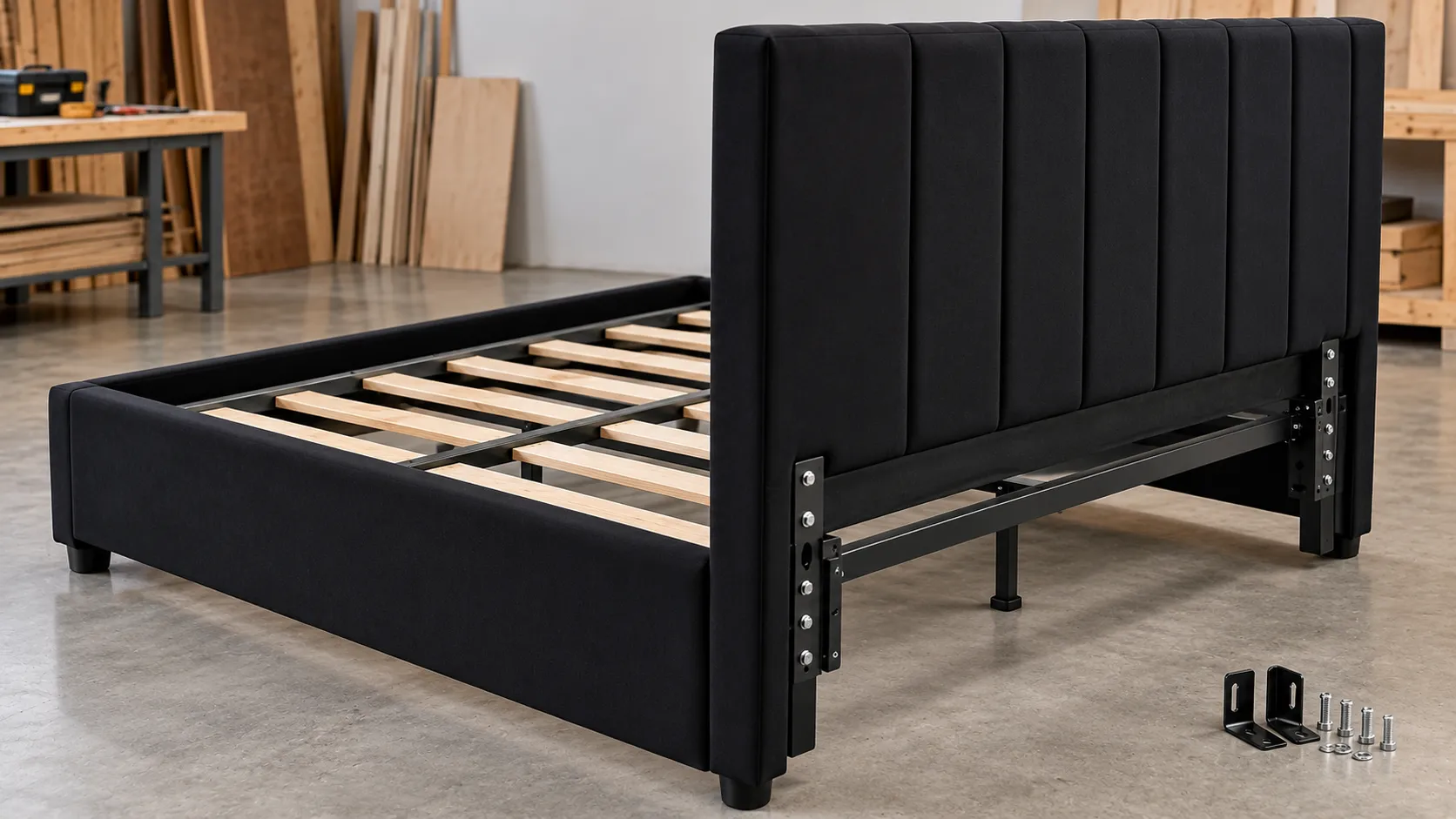
To attach a headboard to a bed frame, first identify how the two components are designed to connect. A compatible frame-mounted headboard normally requires matching mounting points, suitable brackets and the correct fastening hardware. The connection must be secured according to the product’s assembly instructions, with enough clearance for the mattress and surrounding bed structure.
Not every headboard can be attached to every bed frame. Some headboards are built into an upholstered bed, some connect through mounting brackets, and others are fixed independently to a wall. These arrangements require different installation methods.
For furniture manufacturers, installers and OEM buyers, the main challenge is not simply attaching two components. It is ensuring that the headboard is properly positioned, securely supported and compatible with the completed bed.
This guide explains how headboard mounting systems work, what measurements must match and how to assess the connection before installation.
Can Any Headboard Be Attached to Any Bed Frame?
The short answer is no.
Two products may be sold for the same mattress size yet have different mounting holes, structural supports and fixing arrangements.
A headboard and bed frame can be considered compatible only when their intended connection methods can work together without unsupported modification.
Before selecting hardware, identify the headboard type.
Integrated Headboards
An integrated headboard forms part of the finished bed design.
It may be connected to the side rails, surrounding bed structure or internal framework through a specific assembly arrangement.
These connections are not necessarily the same as those found on a separate metal mattress-support base.
For example, Shilong’s Modern Black PU Leather Upholstered Bed Frame is presented as a complete upholstered bed with a tufted headboard and internal metal-and-wood support structure.
The product illustrates an integrated bed configuration. Its published appearance does not establish that the headboard can be removed and attached to any other frame.
Frame-Mounted Headboards
A frame-mounted headboard connects to designated attachment points on the bed frame.
The connection may use direct fasteners, mounting plates, brackets or adjustable adapters, depending on the actual design.
For this arrangement, the installer must identify:
- The structural mounting points on the frame.
- The corresponding mounting points on the headboard.
- The required brackets or connecting plates.
- The approved fasteners and their installation method.
- The final mounting height and required clearances.
A bracket may provide adjustment, but that does not mean it can accommodate every headboard or frame.
Wall-Mounted Headboards
A wall-mounted headboard is supported through a separate wall-fixing arrangement rather than through the bed frame.
Its installation requires suitable wall structure, compatible fixing hardware and a design capable of supporting the headboard under the intended conditions.
The bed may be positioned in front of it, but that does not make the wall-mounted headboard a frame-mounted component.
Do not assume that fixing a headboard to drywall alone provides adequate structural support. The fixing approach must be appropriate for the wall construction and the headboard manufacturer’s requirements.
The three arrangements can be compared as follows.
| Headboard type | Main connection | Important consideration |
|---|---|---|
| Integrated upholstered headboard | Purpose-designed bed structure | Follow the complete bed’s assembly instructions |
| Frame-mounted headboard | Bed frame mounting points or approved brackets | Match holes, hardware, position and structural support |
| Wall-mounted headboard | Suitable wall support system | Confirm wall construction, fixing requirements and bed clearance |
Establishing the connection type first prevents the wrong installation method from being applied to an otherwise suitable-looking product.
What Measurements Must Match Before Installation?
Headboard compatibility depends on the relationship between the mounting points—not simply on the nominal mattress size.
A Queen or King label identifies a general bed-size category within a market, but it does not define a universal headboard mounting-hole pattern.
The actual installation requires measurements from both components.
Mounting Hole Positions and Bracket Alignment
Start by measuring the attachment points on the bed frame.
Record the horizontal distance between corresponding mounting-hole centers. If there are several vertically arranged holes, record their vertical positions as well.
Next, measure the matching points on the headboard.
Use the same reference system for both sets of measurements.
For example, measuring one component from the center of a hole and another from the outer edge of a bracket creates an incorrect comparison.
A mounting-hole schedule should identify:
| Measurement | Why it matters |
|---|---|
| Horizontal mounting-hole center distance | Determines whether the left and right mounting positions can align |
| Vertical hole positions | Affects mounting height and bracket compatibility |
| Mounting surface location | Shows how far the bracket sits from the frame and headboard |
| Available bracket adjustment | Establishes the permitted positioning range |
| Fastener interface | Determines whether the approved fastening hardware fits the connection |
| Surrounding clearance | Identifies possible interference with the mattress, bed body or wall |
Where elongated slots are used, their presence does not remove the need to check compatibility.
The available adjustment must be sufficient for the actual hole positions, and the selected fasteners must remain properly supported in the final arrangement.
Headboard Width, Height and Clearance
The headboard’s overall width affects its appearance, but mounting geometry determines whether it can be installed.
The installer also needs to consider the vertical relationship between the headboard, mattress and floor.
A high upholstered headboard may have a low mounting area concealed behind the fabric.
A separate frame-mounted headboard may need to be raised or lowered to achieve the intended position.
Check whether the final height affects access to mounting hardware, contact with the mattress or clearance from nearby furniture.
For an adjustable bed base, movement clearance is particularly important. A headboard must not obstruct the designed movement of the base.
These measurements should be checked on the actual product or dimensioned drawings rather than estimated from photographs.
How to Attach a Headboard Using Compatible Mounting Brackets
Once compatibility has been established, installation can follow a clear sequence.
The steps below describe the general process for a headboard and frame that are specifically designed to use mounting brackets. They are not a substitute for the instructions supplied with a particular product.
Step 1: Identify the Correct Brackets and Hardware
Check the component list for both the bed frame and headboard.
Make sure the mounting brackets, fasteners, washers and other specified parts are present.
Separate left-hand and right-hand components if the design uses different orientations.
Do not replace a missing fastener with one selected only because it appears to fit the hole.
The correct fastener must match the specified thread, length, engagement and connection requirements.
An unsuitable fastener can damage a threaded insert or fail to secure the connection correctly.
Step 2: Prepare the Frame for Installation
Place the bed frame in the position required by its assembly instructions.
For a frame-mounted headboard, locate the designated attachment points.
Check that those points are accessible and free from obvious damage.
If the bed includes moving or powered components, follow the manufacturer’s preparation and isolation instructions before working on the connection.
Do not treat decorative holes, unused manufacturing features or unrelated openings as mounting points.
Step 3: Position the Brackets
Fit the approved brackets in the orientation specified for the frame.
Where adjustment is provided, use the intended adjustment features rather than forcing the bracket into position.
The brackets should be aligned with the headboard’s connection points while maintaining the required spacing from the bed structure.
At this stage, the installer should confirm that the attachment is geometrically compatible before completing the final tightening process.
If the brackets do not align, stop and investigate rather than enlarging the mounting holes.
Step 4: Align the Headboard
With suitable assistance for the headboard’s size and weight, bring it into the intended position.
Support the headboard during alignment so its weight is not carried by a partially secured connection.
Match the mounting points to the brackets and check that the headboard sits at the required height.
The headboard should not need to be forced sideways or bent to make the holes meet.
If the connection is difficult to align, recheck the bracket orientation, mounting-point measurements and part compatibility.
Step 5: Secure the Connection
Install the specified fasteners according to the assembly instructions.
Where the instructions require an initial loose-fit stage, position all relevant connections before completing the tightening sequence. This helps avoid pulling the assembly out of alignment.
Use the manufacturer’s required tightening method and torque specification, where supplied.
Do not assume that maximum hand force or an impact tool is suitable for the connection.
Once secured, the headboard should remain in its intended position without abnormal looseness or distortion at the mounting points.
Step 6: Check the Complete Bed Assembly
After installation, inspect the headboard in relation to the frame, mattress and surrounding furniture.
Check that:
- The headboard is correctly aligned.
- All required mounting components are installed.
- The connection follows the intended structural arrangement.
- There is no visible damage around the mounting points.
- The mattress and other bed components have the required clearance.
- Any adjustable or moving parts operate without interference.
A headboard that looks straight is not necessarily correctly installed. The structural connection and its clearances must also be checked.
What If the Headboard and Bed Frame Holes Do Not Line Up?
Misaligned mounting holes are a common reason that otherwise compatible-looking furniture components cannot be assembled directly.
The cause should be identified before modification.
Check the Bracket Orientation
Some mounting brackets have a specific left-hand, right-hand, upper or lower position.
An incorrectly oriented bracket can move its connection holes away from the intended location.
Compare the installed arrangement with the product drawing or instructions.
Check the Measurements Again
Confirm that the measurements were taken from matching reference points.
A difference between hole-center spacing and overall bracket width can make a compatible arrangement appear incompatible.
Also check whether the frame is correctly assembled and whether the mounting points have moved out of alignment due to an assembly problem.
Determine Whether an Approved Adapter Exists
Adjustable headboard brackets and adapter plates are available for certain systems.
However, compatibility depends on the attachment geometry, fastener interfaces and the ability of the finished connection to support the headboard as intended.
An adapter designed for one bed base may not be appropriate for another.
Do not assume that an adjustable bracket is suitable merely because its slots appear long enough.
Avoid Unapproved Drilling or Alteration
If the holes do not align, drilling new holes in the bed frame is not a general-purpose solution.
Such modifications may affect the frame structure, damage protective finishes or interfere with other components.
The same concern applies to cutting brackets or welding additional mounting points.
The preferred approach is to identify a documented compatible connection.
If no suitable arrangement exists, a different bracket, headboard or frame configuration may be required.
How Does Upholstery Affect Headboard Attachment?
Upholstered headboards can hide the structure used for mounting.
Their outer fabric or PU leather layer is primarily a finished surface. The actual connection must be made through the structural elements designed to receive it.
A mounting screw passing through upholstery does not, by itself, establish a suitable structural connection.
Find the Actual Support Structure
Before attaching an upholstered headboard, identify the reinforced mounting areas or designated attachment points.
These may be incorporated into an internal frame or other supporting elements, depending on the product design.
Do not assume that every position behind the upholstered surface can accept mounting hardware.
Unsupported fastening can damage the finish without providing a reliable connection.
Consider the Finished Bed Structure
An upholstered bed may combine:
- A padded headboard.
- Decorative or structural side panels.
- An internal metal support frame.
- Wooden support slats.
- Legs and connecting hardware.
The headboard may be designed to connect to the surrounding bed body rather than directly to the internal metal mattress-support skeleton.
These are different interfaces.
Shilong’s Modern Beige Upholstered Bed Frame includes a high-backrest upholstered design, an internal metal frame and wooden slats.
It provides a relevant example of a complete upholstered bed system. However, the published product description does not establish a universal mounting-hole arrangement for separate headboards.
For an OEM project, the headboard connection should therefore be reviewed as part of the complete bed design.
That review should include the internal attachment structure, available installation space and relationship between the headboard and mattress-support frame.
How to Check the Headboard After Assembly
Headboard installation should end with an inspection of the connection—not simply with the final fastener being tightened.
A practical check should examine the assembled position and whether the product behaves as intended.
Connection Stability
Check whether the headboard is properly supported by its designated attachment points.
Look for unusual movement at the brackets, incomplete fastener installation or visible distortion around the mounting areas.
A connection should not depend on the mattress pressing against the headboard to remain in position.
Clearance and Contact
Check the headboard’s relationship with the mattress, side rails, wall and other components.
If the headboard contacts the wall, establish whether that contact is intended by the design.
For adjustable bases, confirm that all relevant moving parts have the required clearance throughout the intended operating range.
Noise and Unwanted Movement
A loose or poorly aligned headboard connection may produce movement or contact noise when the bed is used.
If a sound appears near the headboard, inspect its mounting interface rather than immediately treating it as a problem with the mattress or support slats.
The correct response depends on whether the issue comes from assembly, a damaged component or an incompatible arrangement.
Reassembly After Transport
Knock-down beds may be assembled again after shipping, relocation or storage.
The connection should be checked each time the bed is reassembled.
Do not assume that a bracket remains correctly positioned after the furniture has been dismantled and transported.
The inspection should follow the relevant product instructions and confirm the condition of the hardware before reuse.
What Should OEM Buyers Confirm Before Ordering a Bed Frame and Headboard?
For furniture brands and project purchasers, headboard compatibility should be established before production, not left to the final installer.
The order should make clear whether the project involves a complete upholstered bed, a separate metal bed base or a frame intended to accept an independently supplied headboard.
These arrangements can require different mounting hardware and assembly instructions.
A useful technical specification includes the following information:
| Specification item | Required information | Reason |
|---|---|---|
| Bed configuration | Complete upholstered bed, separate frame or another defined system | Establishes the connection arrangement |
| Headboard type | Integrated, frame-mounted or wall-mounted | Determines the installation method |
| Dimensions | Actual frame and headboard dimensions | Supports dimensional compatibility |
| Mounting interface | Hole positions, supporting structure and bracket details | Establishes connection geometry |
| Hardware | Fasteners, brackets, inserts and related components | Defines the required assembly parts |
| Assembly | Installation sequence and access for tools | Helps ensure the connection can be completed correctly |
| Clearance | Relationship with mattress, surrounding panels and moving parts | Prevents interference |
| Packaging | Hardware sets, component identification and assembly instructions | Supports correct assembly after delivery |
| Sample approval | Confirmed fit and assembled condition | Establishes the intended production configuration |
For custom products, the supplier should return drawings or samples that show the actual connection arrangement.
A reference photograph alone cannot establish mounting compatibility.
Shilong supplies metal and steel-wood bed structures for furniture manufacturing and OEM projects. Its custom metal bed base products provide a starting point for discussing the relationship between a support frame, surrounding bed body and required connecting hardware.
Where a separate headboard is involved, the buyer should provide its actual dimensions, mounting details and intended finished-bed arrangement.
The connection should be assessed as a complete assembly rather than as two independently selected furniture items.
A Reliable Headboard Connection Starts With Compatibility
Attaching a headboard to a bed frame is straightforward only when the two products have a compatible mounting arrangement.
The correct method begins with identifying the headboard type, measuring the connection points and selecting the approved hardware. Installation then follows the specified alignment and fastening sequence, with a final check of stability, clearances and normal operation.
For furniture manufacturers and OEM buyers, these details should be settled during design and sample approval. Doing so helps prevent incompatible brackets, incorrect mounting positions and assembly problems after delivery.
Shilong works with furniture producers and bed-frame buyers on structural and hardware requirements. For a project involving a separate or integrated headboard, buyers can contact Shilong with the frame drawing, headboard dimensions and mounting requirements to discuss the available configuration and the information needed for an accurate assembly specification.